
IDFC First Bank has integrated with ICEGATE 2.0 to enable digital payment of customs duty, central excise, and service tax for its customers.

From the financial year 2025-2026, the government has introduced a new column in the tax return form for presumptive taxpayers, requiring them to disclose their year-end investments. This requirement was not present last year.

The Swadeshi Jagran Manch (SJM) is advocating for the termination of the moratorium on customs duties for electronically transmitted digital products, arguing that it hinders self-reliance, causes revenue losses, and restricts India's ability to tax emerging technologies like AI.

India's like-for-like gross Goods and Services Tax (GST) revenue growth slowed to a five-year low of 5.57 per cent in FY26, reaching Rs 23.32 trillion, primarily driven by a significant surge in import revenues.

DBS Bank India has launched a direct tax payment facility after authorisation from the Central Board of Direct Taxes (CBDT). Utkarsh Small Finance Bank partners with Mumbai Indians as banking partner for T20 League 2026.

ServiceNow Vice Chairman Nick Tzitzon highlights India's potential to develop an AI-native government model, emphasising enhanced public services, data privacy, and economic growth.

Indian insurance companies are bracing for reduced profitability in Q4FY26, primarily due to the rationalisation of GST on retail life and health policies, leading to a loss of input tax credit, coupled with volatility in equity markets impacting investment income.

Godrej Consumer Products Ltd (GCPL) delivered a robust Q4FY26 performance, with steady demand in India and signs of stabilisation in international markets, despite persistent inflationary pressures. The company expects to maintain profitability in FY27 through strategic cost management and pricing adjustments.

Union Minister Ashwini Vaishnaw announced that two more semiconductor chip packaging units, part of the India Semiconductor Mission, are expected to be operational by July and December, respectively. He also highlighted India's focus on becoming a beneficiary of AI technology, expanding data centre infrastructure with significant investments, and developing new subsea cable networks for global connectivity.

Prime Minister Narendra Modi is promoting India as a global hub for digital infrastructure and artificial intelligence, highlighting the government's incentives for data center investments and inviting the world's data to reside in India.

The India-US trade deal has offered a much-needed breather for the Indian information technology (IT) industry, which has been grappling with global macroeconomic uncertainty and subdued client spending over the past few years.

Dabur India's shares rose 3.7 per cent after reporting in-line Q4FY26 results, driven by a healthy 10 per cent growth in its India business, despite some analysts remaining cautious about future execution.

Krutrim, India's first AI unicorn, has successfully repositioned itself as a focused domestic AI Cloud Services provider, reporting its first annual net profit in FY26.

"Policy sales will be one of the focus areas for the company because looking at the large insurance gap, large number of people being uncovered. The only right way to go is to increase the number of policies," said Amit Jhingran, MD & CEO, SBI Life Insurance.

The Union Budget on Sunday proposed a tax holiday till 2047 for foreign companies that provide cloud services to customers globally using data centres located in India, signalling the government's push to make the country a major hub for AI and digital infrastructure.

SIS Ltd, a security and facility management services provider, aims to cross Rs 20,000 crore in revenue by FY27, driven by strong double-digit growth, expansion of its service network, and a simplified regulatory framework under new labour codes, said its Group Managing Director Rituraj Sinha.
The Union Budget on Sunday proposed a tax holiday till 2047 for foreign companies that provide cloud services to customers globally using data centres located in India, signalling the government's push to make the country a major hub for AI and digital infrastructure.

Shares of Avenue Supermarts, operator of DMart, fell 5.2 per cent after reporting mixed Q4 FY26 results, with brokerages offering divergent 'sell', 'buy', and 'hold' ratings based on factors like valuation, competitive intensity, and store expansion strategies.

Budget 2026 is an intentional and ambitious one - From manufacturing growth to services supremacy, from technology consumption to AI-powered transformation. This is the blueprint for a $7 trillion economy built on intelligence, not just scale.

'In investing, poor sentiment is always a good vintage to build a portfolio.'

This Budget positions India's taxation ideology as not merely a revenue source but as a strategic catalyst for growth, inclusion and long-term confidence.

SBI General Insurance aims to achieve a 10 per cent market share among private and standalone health insurers within approximately five years, up from its current 7.17 per cent, said Naveen Chandra Jha, managing director and chief executive officer, SBI General Insurance.

The proposals outlined in Budget 2026-27 represent a carefully crafted, multi-year strategy designed to strengthen India's big bets on the path to Viksit Bharat 2047, says Sameer Gupta.

India is a global leader in software development services, IT enabled services, knowledge process outsourcing services and contract R&D services relating to software development, Sitharaman said noting these business segments are quite inter-connected with each other.

India's online retail market concluded 2025 with electronic retail (e-retail) gross merchandise value (GMV) reaching $65-66 billion, a 19-21 per cent increase, according to a report by Bain & Company and Flipkart. This growth is significantly driven by GenZ shoppers and the rapid expansion of quick commerce, which has emerged as a global leader.

'In India's case, an extended earnings slowdown accompanied by rich valuations have dimmed returns since late 2024.'

'As re-industrialisation gathers pace across regions like Asia, Europe and the US, a wide range of products and inputs will see demand.'

India's rapidly ageing truck fleet, with 42% of vehicles over 12 years old, is set to trigger a replacement-driven growth of 3-5% annually over the next five years.
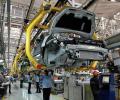
India's passenger vehicle (PV) industry is projected to experience moderated growth in FY27, following a strong rebound in H2FY26, primarily due to the high base effect, absorbed pent-up demand, and the lingering impact of geopolitical tensions in West Asia.

Analysts are increasingly optimistic about India's capital markets, with HDFC AMC, CAMS, and KFin Technologies identified as top investment picks. This optimism stems from a structural shift in household savings towards financial instruments and an expected multi-year earnings expansion for market infrastructure providers and asset management companies.

Tata Consultancy Services (TCS) announced a 12.22 per cent increase in its net profit for the March quarter, reaching Rs 13,718 crore, alongside a 9.64 per cent rise in revenue from operations.

Kerala's voters are sophisticated, educated, and unforgiving. They have once again made it clear that no government is entitled to remain in power. The Congress would do well to remember this, points out Ramesh Menon.

India's gross GST collection increased by 8.1 per cent to over Rs 1.83 lakh crore in February, driven by higher import revenues and improved domestic sales. Despite some states reporting negative or below-average growth, experts see the overall trend as a sign of a maturing tax ecosystem and a confident domestic market.

Greer said that India has taken down some digital services taxes and is moving tariffs down.

Fast-moving consumer goods (FMCG) companies are expected to report mid-single-digit revenue growth in the July-September 2025-26 quarter, according to their quarterly updates. Most companies also noted that supply chains were focused on liquidating existing stock ahead of the implementation of new goods and services tax (GST) rates in categories where the tax was lowered.

Prime Minister Narendra Modi has accused opposition parties of obstructing the passage of the women's reservation bill in Parliament, alleging they have crushed the dreams of women and prioritised selfish politics over national progress.

10 stocks from the Nifty 200 index that offer good growth potential and scope to deliver decent returns from current levels, based on brokerage estimates.

A new survey indicates that Indian employers are planning to increase hiring in the April-June quarter, driven by strong business confidence and domestic demand. The survey also highlights the impact of AI adoption on workforce strategy and the challenges of talent scarcity.

India has clarified its position on the proposed interim trade agreement with the US, stating that the joint statement remains the basis for mutual understanding. Amendments to a White House fact sheet reflect shared understandings, with both sides working towards finalizing the agreement.

With the Union Budget three months away, major industry chambers have submitted to the government proposals on common taxes, seeking simpler compliance and a quicker resolution of tax disputes.
 © 2026 Rediff.com - Advertise with us - Disclaimer - Privacy Policy - Sitemap - Feedback - About us - Terms of use - Grievances